
The real reason behind your repeating patterns: the inner war against yourself
The iron grip that keeps your repeating patterns, stress, anxiety and fear in place is the inner war against yourself. You won’t solve your problems by solving them directly. You’ll dissolve them by ending the war against yourself. To do that you need to see through the subconscious lens of guilt and blame that gives rise to the inner war. And you need to recognise that inner freedom, self-belief, joy and potentiality are not something you find, they’re your true nature–always already present within you.
Have you ever felt lonely while surrounded by your closest family or friends? Ever felt unseen, unheard, rejected in relationships? Have you been trapped in recurring patterns for years? Dating the same person with a different name? Unreaching the same goal? Or have you driven yourself almost to the brink of insanity in pursuit of a goal, only to feel empty once you achieved it? Have you built a good life, but feel alone and miserable in the midst of it? Have the inner freedom, aliveness and joy you’ve been yearning for been continually out of reach?
These are the challenges most of my clients wrestle with. And these are the challenges I have battled with, for years. And so have they with me. And the ride wasn’t smooth. In fact, it was quite bumpy.
I stayed stuck in repeating patterns of rejection, inner turmoil, not-enoughness and loneliness for years. Not because I wasn’t looking for the inner freedom and joy I yearned for, but because none of my solutions worked.
The reason for that was simple, but not simple to see: my recurring problems were not problems, but symptoms. My solutions didn’t work because they were not solving the real root cause of my challenges.
The more I searched the further away I got
For years I poured my soul into overdoing, overworking and overbeing in exchange for approval and acceptance from others.
I feared both loneliness and intimacy. I feared both failure and the cost of fear of failure. I tried to beat my dysfunctional perfectionism and got beaten by it.
I wrestled with the resistance, I went into the resistance, I resisted the resistance.
I hid from relationships and I hid in and within relationships.
I felt I wasn’t enough and I felt I was too much.
I smoked cigarettes, cigars and I drank alcohol. I then quit cigarettes, cigars and alcohol. I didn’t regularly exercise until my mid 30s (minus the first 13 or so years of my life, when in the words of a friend, I was constantly hanging from trees–which I hardly ever was, but the metaphor represents well my way of being during those childhood years) and then I suddenly began doing Crossfit five times a week. I travelled the world for over eight years, in search of something that was never to be found out there, outside of me. I hurt people and I hurt myself. I betrayed people and I betrayed myself. I got married and I got divorced.
I tried to avoid myself in all these ways. And there I still was.
And after playing this cosmic hide and seek, push and pull game for over three decades, I found myself approaching the golden age of fourties–when many people are happily married, have accepted themselves, imperfections and all, their children have become little humans, and they’re well on track to 42, content that they’ve got this–and the answers to life, the universe and everything.
Except–I was in the midst of a divorce, not sure where in the world I belonged, often needing 20 minutes to decide what I was going to order from a menu of four main dishes, befuddled about who I was, and beginning to make a hoard of uncomfortable realisations about myself–that I’d been experiencing CPTSD for years, that I was a highly-sensitive overachiever (HSO), that I’d been in codependent relationships and that my fears, childhood trauma and unquestioned thinking had been largely running my life so far.
This is my story but it’s also the story of many people I meet who after reaching a point of no return, find themselves desiring a life overhaul and midlife reset. Before I show you how to turn your life around at that stage, it’s worth understanding what leads us to find ourselves in these circumstances in the first place.
What keeps us stuck in recurring patterns of not-enoughness, rejection, anxiety and fear of failure
The self-reinforcing loop of avoidance: we create what we try to avoid
Most of us live reactive rather than creative lives. We’re driven by the desire to avoid our fears, rather than by the possibility and potentiality of creation.
You want to have a good relationship because you don’t want to feel lonely. You want to succeed because you don’t want to feel like a failure. You want to find love and approval to avoid feelings of not-enoughness.
This avoidant approach to life means that you’re playing not to lose rather than playing to win. And we’re wired this way, studies show: neurologically, we’re more motivated by avoiding a bad outcome than creating a good one–a phenomenon known as loss aversion.
The problem and irony of having an avoidant approach to life is this: we create what we’re trying to avoid in the act of avoiding it. You engage in perfectionism and overthinking to avoid failure, it takes you too long to finish projects and you end up feeling like a failure. You abandon your boundaries to avoid rejection, but self-abandonment is rejection. You chase connection with others by suppressing your authentic self and end up feeling more disconnected, from yourself and others.
Why is this relevant? Because most of us are driven by our past hurts and the avoidance of the limiting beliefs that childhood conditioning left us with, and that’s what keeps recurring unwanted patterns in place.
I was the archetype of this.
As a child, I felt neglected, abandoned, inferior and not belonging–and for a long time I ran away from re-experiencing the pain of these childhood wounds. And I kept on perpetuating that very same pain.
To avoid rejection, I’d attack people at the slightest sign of rejection, which would lead them to distance themselves, leaving me feeling rejected. To avoid feeling worthless, I’d try to be perfect and get everything right, which led to dysfunctional perfectionism, analysis paralysis and unattainable standards, making me feel like a failure. To avoid abandonment and loneliness, I’d try to find acceptance from people, not realising that that in itself was an act of rejection, of both myself and them. If you’re curious to learn more, I’ve written about the self-reinforcing loop of avoidance and how to get out of it.
The myths and pitfalls
Myth #1: You’re unhappy because you don’t have enough success, confidence, love or inner freedom.
You think you are an impostor and somehow not enough because you don’t create enough impact. You think you’re miserable and unfulfilled because you haven’t accomplished your deepest dreams. You feel rejected and misunderstood because you haven’t found the right partner. That you’re anxious and stressed because you have too much to do.
That’s a fallacy.
Your unhappiness, not-enoughness, self-doubt, relationship issues, inner turmoil and anxiety aren’t due to anything you lack. They’re the result of your inner war against yourself.
There’s an inner voice that’s talking to you and it’s often not very kind. You might find it constantly nagging you to be different, better and ever more than you are. Do this, don’t do that. Be this, don’t be that. Say this, don’t say that. You’re under the yolk of a relentless perfectionist internally that’s evaluating every single thing you are, think, feel, and do, demanding and disciplining, comparing and scoring, making perpetual plans to improve you.
This inner critical voice shoulds all over you–you ‘should’ be more productive, more successful, more generous, more at peace, more put together, less anxious, less hesitant, less needy. You ‘should’ stop procrastinating and start exercising more. You ‘should’ stop overthinking, get out of your comfort zone and take more risks. You ‘should’ stop being so harsh on yourself. You ‘should’ be harsher on yourself. You ‘should’ stop comparing yourself to people. You ‘should’ stop criticising yourself for comparing yourself to people. That voice is never pleased and it’s often contradicting itself.
This relentless inner war leaves you feeling exhausted, anxious, lonely and disconnected, from yourself and others. It veils your true nature and inherent qualities of being–inner freedom, wisdom, confidence, creativity and joy–in a constant stream of chatter.
Symptoms of the inner war:
Recurring patterns and challenges
Anxiety, overwhelm, stuckness, burnout
Overworking, over-giving and over-being
Looping thoughts
Self-doubt and not-enoughness
Perfectionism and people-pleasing
Self-judgement and a loud inner critic
Inner emptiness
Recurring feelings of guilt and a sense that you’re doing something wrong
Avoidance, numbing, procrastination patterns
Indecisiveness, difficulty prioritising and setting boundaries
Lack of vibrancy, joy and aliveness
Myth #2: You’ll feel happy when you achieve more, find the right partner, advance your career.
You might believe that when you iron out your deficiencies, and carve out the uber-productivity routine, get on top of your to-do-list, find the perfect loving partner–you will finally feel good about yourself.
That’s a misconception. Your results don’t create your state of being. Your state of being creates your results. This is how it works:
The myth:
You feel you are an impostor because you don’t create enough impact.
The truth:
You don’t recognise the impact you create and you don’t take the actions to serve even more powerfully because you believe you’re an impostor.
The myth:
You feel rejected and misunderstood in relationships because you haven’t found the right partner.
The truth:
You haven’t found the right partner because you feel rejected and misunderstood.
The myth:
You’re anxious and stressed because you have too much to do and not enough time.
The truth:
You feel you don’t have enough time because you’re in a constant state of fight-or-flight, that prevents you from prioritising clearly and leaves you trying to fit the infinite within the finite amount of time all of us have.
The myth:
You are miserable and unfulfilled because you haven’t accomplished your deepest dreams.
The truth:
You haven’t accomplished your deepest dreams because you are miserable and unfulfilled.
It’s not that you’ll find inner freedom, aliveness and joy when you achieve your goals. It’s that when you recognise the inner freedom, aliveness and joy that are your state of being, always already present within you, you will align with that state, and achieve your goals.
Myth #3: You feel lonely because people don’t value and appreciate you enough.
When I found myself in the midst of mid-life collapse and crisis at 40, I realised that my relationship issues, persistent not-enoughness, and anxiety were not the problem–they were symptoms of the problem.
It wasn’t other people that rejected me, abandoned me, or told me I wasn’t enough–it was myself.
I felt unseen and unappreciated by others, because I wasn’t seeing and appreciating myself. My unloving relationships with people were a byproduct of my unloving relationship with myself.
The connection and belonging I’d been looking for all these years was, first and foremost, with myself. I’ve been yearning to remember and come home to who I truly was–to reconnect with my authentic and most empowered self and my inherent qualities of being.
The cause of your outer disconnect and loneliness is your inner disconnect from yourself. You feel misunderstood and unseen not because people are not seeing you, but because you aren’t seeing you.
The inner war might have compelled you to abandon aspects of yourself in exchange for being the person you believe others want you to be. You’re wearing a costume, in a way. And you attract unavailable partners and the experience of feeling unseen and unheard, because they see the costume, not you. This also prevents you from receiving the love and appreciation that are there in your relationships–because you don’t know if they’re for you, or for your costume.
Myth #4: Inner freedom, confidence and joy are something you find.
Inner freedom, love and joy are your inherent qualities of being, always already present within you. They aren’t something you get, they’re who you already are–your true nature. You never lose them, but you might often lose the awareness of them, as it gets veiled by the inner war.
Ending the inner war
I want to show you that even in the face of persistent self-doubt, self-blame and self-abandonment, ending the inner war, breaking repeating patterns and connecting with your true nature is possible for you, as it was for me.
It is possible to turn your life around, build deep and nurturing relationships and live from flow, not fear.
It’s possible to break free from the repeating patterns of not-enoughness, to overcome the fear of expressing your authentic self and to create a vision for the future that deeply moves and energises you.
It’s possible to replace that inner emptiness and turmoil with the vibrancy of self recognition and the joy, creativity and aliveness that are your true nature.
You are what you’re looking for
There’s a story about a young musk deer that one day noticed a heavenly scent in the air. Intoxicated by the smell, he set off to look for its source. He roamed mountains and forest for years, smelling trees and bushes, tasting leaves and blades of grass, looking for the source of the divine aroma. One day, after years of searching, he collapsed to the ground, exhausted. And as he did his horn accidentally pierced his belly, and the air filled with the essence he’d been looking for.
The more I reckoned with my inner war and unlovability, the more I began to see something, or rather feel something, that had been buried for years. An inner knowing. A suppressed lifeforce. An aspect of myself that was full of creativity, joy and wonder, that has been both hiding and longing to express itself. Intuitively, I knew that that was my true nature–the deepest truth of who I’ve always been. It was the most vulnerable and the most invincible part of me. The most personal, yet most transcendent. The most authentic and most ineffable. The me that was prior to everything, of everything and beyond everything. The me that I was longing to come home to.
My journey of homecoming
My own homecoming unfolded in three stages and entailed transformation in the three centres of intelligence that govern our way of being–head, heart, and gut. Cognitive intelligence (thinking), emotional intelligence (feelings) and instinctual intelligence (nervous system and actions).
The first stage began when I recognised that my childhood trauma had created an inner war within me, and that was causing me to attack, abandon and self-sabotage myself.
I was a very sensitive child (HSP), and it was my perception that I was criticised often and usually for many different things. It wasn’t one or two things I seemed to be doing wrong, but somehow almost everything. That left me with the belief that I somehow must be fundamentally flawed and bad.
I also felt responsible for my parents’ happiness and guilty for failing to make them happy. That’s the subconscious architecture upon which my conditioned shame and guilt rested. I believed myself to be bad, undeserving, and inferior for years–without realising it. These confining beliefs gave rise to my inner war, and my inner war gave rise to my self-doubt, not-enoughness, anxiety and fear.
I compensated by being too much or not enough, with patterns of perfectionism, overbeing, overdoing, always having to be right, always trying to get it right. Being too much/not enough are two sides of the same coin, both compulsive behaviours driven by underlying feelings of unworthiness and not-enoughness. John Bradshaw described it as being more-than-human or less-than-human. I find this very apt. The dynamic is created by toxic guilt and shame.
I interrupted my self-abandonment and lone-wolfing patterns and sought support. I started working with a therapist and with a nondual teacher. I invested in my business, in further training and in working with different coaches. I deepened my nonduality studies, having seen the profound effect they had on expanding my inner freedom, and healing my deep-seated existential fear and isolation.
The right books, mentors, teachings, courses and opportunities seemed to find me just when I needed them and I followed the trail.
Deep and lasting transformation requires work on all three levels of intelligence, and I did self-work on all three.
Cognitive inner freedom: from identifying with thoughts to questioning thoughts
On the level of thinking, the overall shift was from identifying with thoughts to questioning thoughts.
Emotional inner freedom: from avoiding feelings to feeling feelings
Emotionally, the shift was from avoiding painful feelings to feeling them, including the deep-seated rejection, abandonment, anger, guilt and shame that childhood trauma had left me with.
Nervous system inner freedom: from fearing fear to embracing fear
My instinctual transformation was about moving from mistrusting life to trusting life–from fear to freedom. Along with that, I worked on expanding my nervous system’s capacity to feel all frequencies and states.
As this unfolded, I felt more inner freedom, intimacy, wholeness and trust–regardless of what was going on around me.
Mentally, I felt more inner peace and my sense of self expanded. My clarity grew, my discernment became sharper and my creativity increased.
Emotionally, I felt more intimate and connected, within and without, I became more gentle with myself, and my decision-making improved.
My existential angst lessened, I felt more grounded and more stable. My compulsive controlling behaviours began falling away and I found it increasingly easy to surrender to and be guided by the flow of life. My trust in my inner knowing and my connection with my higher guidance deepened.
I became bolder, more fluid and more intuitive in my work with clients and that improved the results they were getting.
And I experienced more joy, love and gratitude, and felt more energised, vibrant and alive.
I know I’m not alone in these experiences as the benefits of authenticity and self-connection have been well-proven by research. Studies show that we are happier, more creative, more self-reliant and less lonely when we are connected with our authentic selves. We also have better self-esteem, a stronger sense of meaning in our lives and experience less impostor syndrome.
The voice behind the inner war and the biggest obstacle to transformation: the subconscious lens of guilt and shame
When the New Testament of the Bible was being curated, the bishops and theologians responsible for recommending texts for inclusion had a choice between two very different portrayals of women.
One of the texts described women as intellectually and ethically inferior to men. Women, it said, should learn quietness and submission and should not teach, nor assume authority over men. Another text, the Acts of Paul and Thecla, saw women as equal and authorised them to have leadership roles within the church.
Thecla, a disciple of Saint Paul, was one of the most revered Christian saints for her ability to perform numerous miracles and baptise herself with her own hands. Her contribution was seen as evidence for women’s equality in Christian communities.
We see ourselves and our world through a subconscious lens that filters our perception. And because it’s subconscious, we are blind to the fact that it blinds us.
How much of the violence that women have experienced over the last 2,000 years is a result of the perception that they are inferior? How might our relationships, families, communities, organisations and economy evolved had the Bible included the text that described women as equal?
We all look at life through a subconscious lens programmed by childhood experiences and the norms and narratives of our caregivers and communities. That invisible lens shapes our way of being, thinking and feeling in the most profound of ways. The inner war is the by-product of that subconscious lens.
The inner war is the by-product of the subconscious lens you look through

The second stage of my homecoming unfolded when I identified and began to see through the subconscious lens that had created my inner war. That was challenging–because I was very steeped into that confining self-view, blinded by and blind to my subconscious lens.
Damned if you do, damned if you don’t
The potent and silent force that feeds the inner war is the syndrome of conditioned toxic shame and guilt.
The critical voice that ‘shoulds’ all over you is the voice of guilt and shame.
You can’t win against shame and guilt. You’re damned if you do and damned if you don’t. You lose when you lose, and you lose when you win. The goal post keeps moving and the farther you go, the farther you are.
Shame shames you for feeling shame and it shames you for not feeling shame. It creates doubt that you’re worthy of the fulfilment, love, joy and connection you crave. That doubt, often subconscious, feeds self-sabotaging patterns and is the greatest obstacle to transformation.
Shame is about who you are being, guilt is about your actions. Shame says that you’re wrong, guilt says that you’re doing something wrong. In response, you’re always trying to be right and do everything right. Shame tells you your authentic self is somehow flawed and broken. Guilt blames you all the time–for all of your perceptual failings, short-comings, dysfunctions and other people’s unhappiness.
If the voice in your head bristled with “I don’t have shame!”, if expressing your authenticity feels scary, if there’s shame around freeing yourself from guilt and shame, that’s coming from the voice of guilt and shame.
Shame is the evil twin of self-judgement. We glorify self-judgement, regarding it as a noble act of self-betterment, when in fact it’s a costume that shame wears to make itself more acceptable and trick you into letting it pull your strings. That’s how shame works. It’s very cunning.
Childhood trauma create toxic shame and guilt: we abandon ourselves when we’ve been abandoned
Conditioned shame and guilt are the byproducts of childhood trauma and emotional abandonment.
As children, we take adults’ behaviour personally, rather than seeing it for what it is–the helplessness of people who were stressed out and in their own inner war.
If you weren’t accepted for who you were as a child, if you were often criticised and unfavourably compared to others, you might have interpreted that to mean that something’s wrong with you. In response, you might have formed a false core belief that you were not good enough, not deserving, inferior, or even bad. Shame and guilt arise in response.
When I realised that the voice behind my inner war was the voice of toxic guilt and shame, I knew that self-acceptance was the pathway to healing. Both my direct experience and all the literature and research I’d read confirmed that.
But–the idea of accepting myself made me feel so uncomfortable!
Who on earth was I to love and accept myself, with all of my wrongness, unlovability, flaws of character, and shameful traits? Who was I to want to be myself, when clearly the self that I was was so unacceptable? How could I possibly love myself unconditionally, when I was so bad and undeserving, when I’ve made so many mistakes?
The thought of telling people that I was learning to love and accept myself felt so shameful. I heard all of their criticism and ridicule in my head. They’d think I was an arrogant and narcissistic ego maniac. That surely I must first better myself in so many ways, before I could even begin to consider accepting myself.
I understood that all of that resistance and dramatising came from the guilt and shame themselves. These all were the thoughts of my wounded inner child part was deep-programmed to feel guilty and to blame itself. And that guilty part was blaming itself for wanting to feel confident, connected and self-expressed.
Seeing through that self-referential mechanism and welcoming and loving that part and all aspects of myself were the third stage of my homecoming–and the most challenging part.
To stop the inner war and come home to your true and most empowered self, you need to see through the most deeply ingrained confining belief of your guilty and shamed wounded inner child:
The foundational false belief toxic shame and guilt rest upon–“Something’s wrong with me.” The lie of fundamental lack and flaw.
Related confining beliefs: “I’m bad.”, “I’m not good enough.”, “I’m not valued and respected.”, “I’m insignificant.”, “I don’t deserve happiness, inner freedom, love, success.”. Anything that denies the inherent goodness, worth, beauty, value and significance of your true self.
The impact of believing that lie is far-reaching. These are some of the markers:
Recurring and deep-seated feelings of shame, guilt, embarrassment, humiliation, smallness, insignificance, superiority/inferiority patterns.
Thinking that you’re always doing something wrong, you beat yourself up for your ‘mistakes’, you’re afraid of failure, you engage in endless perfectionism, you’re always trying to do the right thing.
Feeling undeserving and unworthy of your needs and deepest wants: love, connection, joy, freedom and aliveness.
Recurring patterns and self-sabotaging behaviours.
The guilty wounded inner child part is conditioned to shame, guilt and fix itself. And the way you free this helpless child from this loop, and from causing more havoc in your life, is by giving it what it’s been yearning for and have never received–unconditional love and acceptance.
The way out of shame and guilt, ironically, is by accepting, welcoming, feeling and loving your shame and guilt. Not changing it, not wanting to get rid of it, not avoiding it–but feeling it and accepting it.
Ending the inner war and coming home to the truth of who you always already are
Ending the inner war against yourself, and beginning your journey of homecoming requires transformation on all three centres of being and intelligence: thinking, feeling and actions.
A core confining belief is stored on each level: as a thought, as a feeling, and as a nervous system reaction. Breaking free from repeating patterns requires that the belief is seen through and liberated on all three. If you’ve been stuck in a recurring problem that’s because you haven’t freed its imprint on all three levels.
Many people don’t achieve lasting transformation because they don’t approach self-discovery in this holistic way. Some focus on self-realisation through meditative and spiritual practices, others on unravelling conditioning through therapy, others yet on somatic practices.
Deep transformation unfolds when patterns are identified, investigated and liberated on all three levels.
First, on the level of mind, you recognise that any core confining beliefs you have about yourself are the by-product of childhood conditioning, and do not represent the truth about who you are. You aren’t inherently bad, unworthy, or less than. Far from it. You don’t need to be perfect to deserve love, approval and acceptance. Being you is enough. No child is born bad. Your true nature is inherently loving, kind, free, wise and complete.
Second, you realise that love and approval aren’t something you get from other people, but something you are responsible for giving yourself. This empowers you and moves you out of victimhood mentality into creator consciousness.
Third, you feel all of your feelings and fears, instead of avoiding, suppressing, or soothing them. This helps you to dissolve repeating patterns, heal depression and anxiety, and feel safer and more joyful.
And you can get help achieving this state and seeing changes in a matter of weeks, or months, even if like me, you’ve felt this way for years.
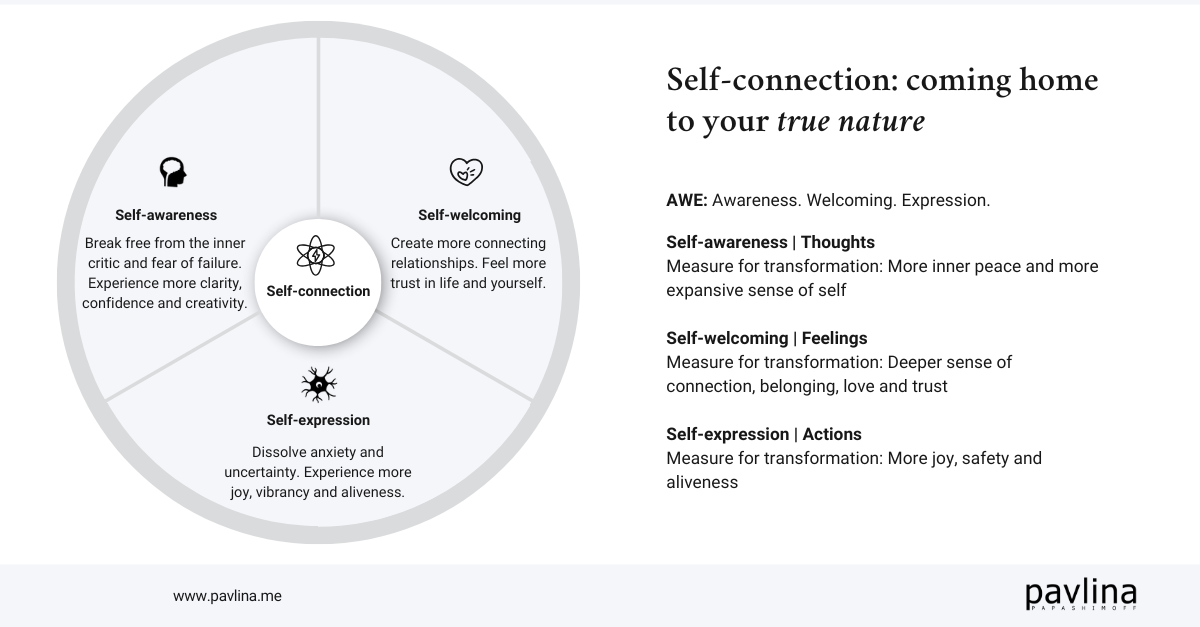
Self-connection is built upon authentic self-awareness, self-welcoming and self-expression
My coaching methodology is designed to help you create lasting transformation by dissolving the limiting recurring patterns on all three levels.
We work on the levels of self-awareness (thoughts), self-welcoming (feelings) and self-expression (actions and nervous system), to help you break free from repeating problems, self-doubt, anxiety and overwhelm, and connect with the inner peace, creativity, love and joy that are the nature of your most empowered self.
A client’s success story: “It was a disaster”
A client shared a success story after returning from a family holiday with her husband, two young children and her parents and brother. “It was a disaster!” she said. “My parents were as neglectful, self-centred and insensitive as ever. And I felt great. It didn’t affect me at all. And I actually had so much compassion for them.”
My client had been a sensitive child, who’d been deeply hurt by her parents’ criticism and apparent lack of acceptance. For years, she’d been trying to prove herself to them to receive their love. That abandonment wound was the source of her inner war, silently shaping patterns in her relationships, work and way of being.
Her parents hadn’t changed, but she had. Having found within herself the love and acceptance she’d been looking for, she experienced her parents very differently.
We tend to think that we feel the way we feel because of other people. The reality is that people’s actions trigger what’s yet unresolved within us. Our experience of life is created entirely from the inside-out, by the thoughts we’re believing.
When you heal your wounds, peoples’ actions no longer trigger you because there’s much less to be triggered. And as your ability to love and accept yourself for who you are increases, your ability to love and accept others for who they are increases also. This in turn improves your relationships.
I believe that we are here to reconnect with the truth of who we are–and that in ways we don’t understand, life designs a path, tailor-made for each of us, to support us in that.
Counterintuitively, the inner war is, for some of us, life’s way of loving us back home–to the primordial wholeness and essence of our true nature.
The heartbreaks–the opportunities that show you the path to your authentic self, breaking your heart open to the love that you are.
The failures–the recognitions that your worth and value have nothing to do with accomplishment, and are your true nature.
The loneliness–a reminder of how deeply you yearn to belong with the truth of who you are.
I have no evidence to support the claim that life’s guiding us home to the souls that we are. But I have plenty of evidence of the suffering I experience when I’m at war with myself and see myself as a separate and lonely victim of life.
And I choose to choose inner freedom, truth, love and joy over inner turmoil.
And if this is something that speaks to you, and you are on your own path of wanting to break free from recurring patterns and not-enoughness, and live with confidence, inner freedom and joy, I would love to have a chat.
I work with sensitive, ambitious, growth-driven individuals who have outgrown surface-level fixes and are ready for lasting change. If this is you, and you are curious to explore how we can partner, you can book a discovery call with me.
Cover photo by Ashley Batz on Unsplash