
How to break free from repeating patterns and self-sabotage and build self-belief and confidence
The hidden reason behind repeating patterns: emotional avoidance. Use this neuroscience-informed guide to end self-sabotage, dissolve emotional blocks, and create lasting change.
I was stuck in undesirable patterns for years. Feeling disconnected and alone, being rejected, attacked and abandoned, doubting myself, feeling not enough, being afraid of failure. And ultimately–being afraid of being fully myself and seen for who I am.
The more I tried to get out of these fears and patterns, the more they seemed to take over me.
And the longer I was under the spell of these fears and patterns, the more afraid I seemed to feel of them. The longer I was not looking the monster in the face, the more and more scary the monster became.
My fear of messing things up became more paralysing. So did my fear of being abandoned, left out, and not good enough. The critical voice in my head became louder and more abusive.
And I seemed to be doing more and more of the things I was telling myself I shouldn’t do–doubting myself, overthinking, procrastinating on important tasks–and less of the things I was afraid of–taking risks, getting messy, speaking my truth, having the difficult conversations.
I had awareness of my limiting beliefs, yet I continued to believe them and be held by them.
The questions that began cracking the patterns
There’s wisdom in the undesirable patterns. All of our behaviours, regardless of how maladaptive they may appear, are in fact adaptive. They serve us more than they harm us–even if that “service” is a disservice.
And so I began wondering and asking myself what made it that it felt safer for me to stay within these undesirable patterns rather than break free from them?
How did self-doubt and not enoughness serve me and keep me safe? What exactly were they keeping me safe from? Was it safer to buy into them or not buy into them?
What keeps you looping in repeating patterns are feelings you’re afraid to feel
And what I realised was this: the hidden reason behind my repeating patterns was emotional avoidance.
The repeating patterns were protecting me from feeling feelings I didn’t want to feel. And avoiding the feelings was what kept me stuck in the patterns.
I discovered that behind my fear of failure and perfectionism was fear of experiencing embarrassment, helplessness and guilt. I was trying to get everything right and perfect, so that I didn’t have to feel ashamed or worthless.
Behind my recurring relationship conflict was fear of feeling attacked, unloved, abandoned and helpless.
Behind my inner war against myself–ie the critical voice in my head–was fear of feeling unsafe, insecure and trapped.
Feelings are the real driver of our actions
We make decisions based on the emotional states we want to experience and the emotional states we want to avoid. Then, we use the intellect to justify how the decision is the right decision.
How many of the decisions you made in the last couple of days were so that you feel valued, loved, safe and free? How many decisions did you make to avoid feeling insecure, rejected or bad about yourself? How many decisions did you make, so that you don’t get in trouble? Or so that you don’t experience fear?
Neuroscientist Antonio Damasio’s research shows that when the emotional centre of our brain is suppressed, we struggle to make decisions. Despite having high IQ, people with damage to the ventromedial prefrontal cortex of the brain (the area connecting emotion and cognition) were incapable of making simple decisions, e.g. they’d need hours to decide where to eat or ten minutes to choose what pen colour to use.
Emotional avoidance is a trap
We experience the fears and feelings we’re trying to avoid
There’s double irony in avoiding feeling your fears and feelings. The avoidance not only keeps your undesired patterns in place, it also creates the feelings and the reality you’re trying to avoid.
For example, to avoid feeling attacked and ashamed of messing things up, I’d try to get everything perfect, spend too long on projects, not take enough risks, then criticise myself for being too risk averse and end up feeling attacked and ashamed.
To avoid feeling insecure and unsafe, I’d be at war with myself internally, constantly trying to improve myself, and that inner attack would leave me feeling unsafe and insecure all the time.
To avoid feeling rejected and unloved, I’d criticise people at the slightest sign of rejection. They’d then criticise me back or distance themselves from me, and I’d feel rejected and unloved.
The avoidance of feelings is what keeps undesired pattern in place
Not feeling the feelings we’re scared of–fear, sadness, anger, grief, rejection–is what keeps us stuck in undesirable patterns, unhealthy behaviours and addictions.
Behind any of the patterns that might be holding you back, such as self-doubt, procrastination, dating unavailable people, impostor syndrome, self-defeating behaviours, there’s a suppressed emotion–a feeling that you are afraid to feel. And the suppression of that feeling is what makes the pattern persist and reoccur.
Neurobiologically, repeating patterns are the body’s and nervous system’s attempt to return to homeostasis.
Feelings we haven’t fully felt and processed get trapped in our system and the body’s tissues and energy field. They become energetic blockages that disrupt the natural flow of life force through us and create physical, emotional, and cognitive imbalances. To rebalance, we need to feel and process the unfelt and trapped feelings. This releases the energetic blockages and returns the body to homeostasis. And when we feel the feelings we’re avoiding, the undesirable patterns stop recurring.
The feelings you’re afraid to feel were programmed in your childhood
The emotional states you avoid and are afraid to feel were programmed in your childhood. They are feelings you experienced as a child but suppressed from fully feeling because they were too scary to feel.
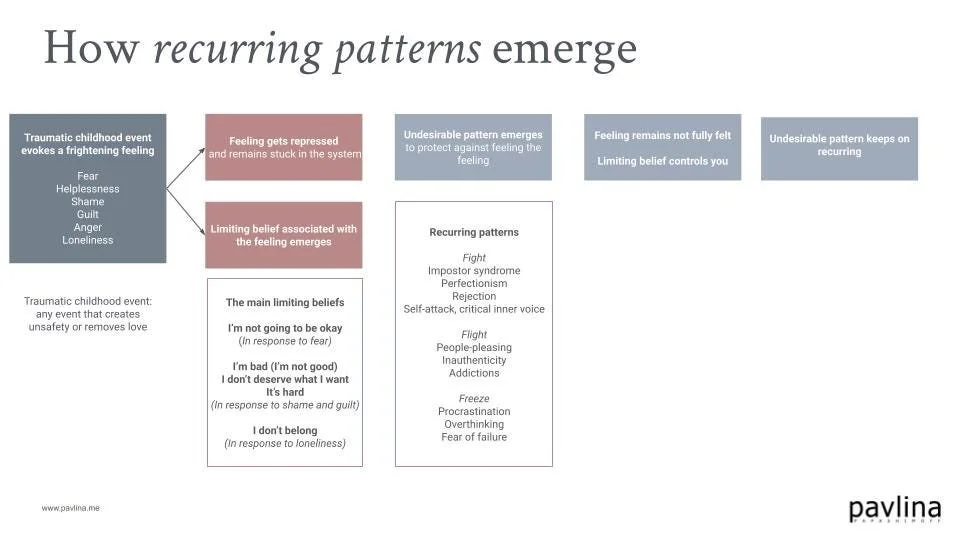
This is how repeating patterns and emotional avoidance emerge:
You experience a traumatic childhood event. For a child that’s any event that creates the experience of lack of safety or lack of love.
The event evokes a feeling, such as insecurity, shame, unsafety, helplessness, guilt.
The feeling is too overwhelming for a child to feel and your system suppresses it, creating an inner wound of a kind that remains frozen within you.
You create a limited belief in response to the event and feeling.
Protection strategy emerges to prevent you from feeling that feeling again, such as self-blame, trying to get everything right, not being your authentic self.
The feeling remains unprocessed and the undesirable pattern keeps on looping.
For example:
Traumatic childhood event: being excessively criticised
Feelings that get repressed: shame, guilt, helplessness, anger; fear of attack and abandonment
Protection strategy:
To prevent shame: perfectionism, blaming and judging people
To prevent guilt: people-pleasing
To prevent fear and helplessness: self-criticism, self-blame, rejection, controlling behaviour, worry
You use the protection strategy in order not to feel the feeling. To avoid feeling helpless, you try to control everything. To avoid feeling guilty, you people please and don’t speak your truth. To avoid feeling shame, you blame others, you blame yourself, you try to get everything perfect.
The feeling remains unfelt and the undesirable pattern continues.
How to break free from undesirable repeating patterns
Breaking the chain of repeating patterns requires cognitive, emotional and nervous system work. Cognitively, you need to see through any beliefs that prevent you from feeling your feelings and fears. On an emotional level, you need to feel the feelings and fears. And on a nervous system level, you need to create safety.
Step 1: Cognitively: see through the limiting beliefs that prevent you from feeling your feelings and fears
1: Trying to avoid the emotion or fear makes you experience the emotion and fear
Understanding that the avoidance of fear and emotions is not only futile, but it actually makes you experience the feeling and the fear you’re trying to avoid is a major first breakthrough.
2: Overcome any shame and guilt you have around your repeating patterns by feeling the shame and guilt
Shame and guilt stagnate. They cement patterns in place. Around all of your repeating patterns and anything else that hasn’t changed in your life for a significant period of time, there’s shame and guilt. Feel your shame and guilt, look forward to them and feel them whenever they come back.
3: You won’t act like an animal if you feel your feelings–and you might act like one if you don’t feel them!
You might believe that if you felt your feelings, they’d take over you. You might be afraid of feeling anger, because you believe it’s shameful or because you’re afraid you’ll destroy. But anger only becomes destructive when we direct it at someone or at ourselves, or when we suppress it, which eventually leads to it exploding, whether inwardly as depression or outwardly as attack on others. We lose control to emotions when we suppress them, not when we feel them.
4: Feelings are not shameful, there’s intelligence and wisdom in all of them
I used to be ashamed of being an emotional person. My definition for that was someone who experienced strong emotions and was moved by them as opposed to someone who was the paragon of cool-headedness, emotionlessness, and rationality. I looked up to all those level-headed people and wished I had their cool blood, composure and control. I wanted to be devoid of emotions.
But the truth is feelings are data and there’s intelligence in all of them. Shame shows me where I’m not being fully myself. Guilt shows me that I’m neglecting my needs. Anger shows me that my boundaries are being crossed. And all of this is information that teaches me how to be myself, take care of myself and love myself.
5: All feelings, when fully felt, actually feel pleasant
We are afraid to feel feelings because we believe that it will hurt. But what hurts is the resistance to feeling them, not feeling them. Think of it this way–we need to close in order not to feel. That’s a form of resistance, you need to exert force and push experience away, and that creates tension and stress both in the musculature of your body and in your mind. Conversely, feeling is a form of relaxation, allowance and openness to experience. You most likely know the lightness you feel after a good cry.
In my experience, the more I feel feelings, the more pleasant they feel. Sadness creates an experience of self-connection and intimacy, and ultimately gratitude. When I feel my helplessness, I experience relief, trust and empowerment.
6: Suppressing your feelings is denying your authenticity
Your feelings are guiding you back to your most authentic and empowered self. Suppressing them and not exploring the wisdom they carry for you prevents you from connecting with your truest and most empowered self.
Step 2: Emotionally: the AWE of feeling feelings
Notice that there’s a moment when an uncomfortable feeling that you don’t want to feel arises within you, and at that moment, you move to an action that prevents you from feeling the feeling. For example:
Fear of messing things up arises > You suppress feeling it > You decide to postpone the customer call until tomorrow
Fear of being criticised arises > You suppress feeling it > You decide to spend another day on the project
Fear of disappointing someone arises > You suppress feeling it > You ignore your needs
Fear of rejection arises > You suppress feeling it > You judge and criticise others
Fear of feeling trapped arises > You suppress feeling it > You go to the fridge
To interrupt the patterns from looping, you need to feel the feeling you suppress. When fear of abandonment arises, feel the abandonment. When fear of being criticised arises, feel the attack of criticism. When fear of being misunderstood arises, feel the helplessness in that.
AWE: a framework for feeling feelings.
AWE is my framework for feeling feelings. This is how it works:
Awareness: become mindful of the fear, anxiety, friction, tension, constriction, discomfort, within you.
Welcoming: welcome the feelings and the sensations. This is a somatic action of releasing the inner grip–softening around experience, opening to it, and embracing the feelings and sensations.
Expression: let the feelings express themselves, let them move through you and run their course, look forward to them and allow them any time they come back.
When it comes to bigger themes of repeating patterns in your life–dating unavailable people, control issues, dysfunctional perfectionism, impostor syndrome and not-enoughness–the process is the same. Identify the feelings the pattern is protecting you from feeling, feel them, welcome them any time they return, and feel them again. This will interrupt the patterns.
Step 3: Nervous system: overcome fear and create safety
On a nervous system level you need to create safety in order to help your body get out of the reactive fight-flight-freeze response that the fear causes. Here are some techniques that help:
Somatic presence: Feel your body, feel its interior, feel any sensations that are moving through it. Feel your feet. Feel your hands. Feel the energy that moves through your body. Enjoy feeling it.
Identify your biggest fear and then feel it. To identify the fear, ask yourself what you’re afraid would happen? And then what? And then what? And then what? Keep on asking until you get to the foundational fear. Then, feel it. Stay with it for a good amount of time. Let it move through your body. And then ask yourself what it taught you? And if feeling it was as bad as you thought it would be?
Ask questions about your fears and uncomfortable emotions. For example:
What would it be like to feel criticised and enjoy it?
What would it be like to be rejected and feel more intimate and connected with myself, as well as with the person who’s rejecting me?
Is it true that I am unsafe if I’m attacked?
What would it be like to be attacked and feel safe? And not attack myself? And not leave myself?
Enjoy whatever you’re doing. We can’t be in fear and in joy at the same time. Welcome, love and enjoy your experience of this moment, as it is, all and any of your feelings, thoughts, fears, anxieties.
~ ~ ~
To what degree has fear been preventing you from taking action you wanted to take? Helping clients get out of fear and live and create from possibility and joy is a key aspect of my work. If self-doubt, incessant not-enoughness, overwhelm, burnout, anxiety and fear are something you’ve been battling with, feel free to reach out and see how I could help.
Cover photo by Rémy Penet on Unsplash