
The loop of avoidance: you experience what you avoid with the very attempt to avoid it
Are you playing to win or playing not to lose? The difference is crucial. Your desires are either avoidant or creative. When you’re driven by avoidance, you experience what you’re avoiding.
When it comes to what we want to attain in life, we are in either one of two energies about it–we are avoidant or creative. In other words, we are either driven by our core fears or by possibility and creativity.
The same goal, for example, wanting to make money could come from either an avoidant or creative place.
Avoidant desire: you want to make money because you’re afraid of poverty
Creative desire: you want to make money because you enjoy affluence and expressing your potential
Avoidant desire: you want to be in a relationship in order to escape loneliness
Creative desire: you want to be in a relationship in order to share your life with someone
Avoidant desire: you want to build a successful business because you feel insecure
Creative desire: you want to build a successful business because you are curious about what you can create
The problem: the self-reinforcing loop of avoidance
The problem with avoidant and fear-driven desires and goals is this: you experience what you’re trying to avoid in the very act of trying to avoid it.
For example:
You want to avoid failure > You engage in perfectionism and overthinking > You’re too slow to execute > You feel like a failure.
You want to avoid feeling out of control > You try to control everything > Things don’t go according to plan > You feel out of control
When your desires are avoidant and fear-driven, achievement might feel not too different to failure
There are two types of avoidant strategies: over-doing or under-doing: being too much or being not enough. The person with the successful career, shiny corporate car and big house could be driven by the same fear of failure as the person who doesn’t have a home and lives on the street.
One’s reaction to their fear of failure is over-doing, the other’s undergoing, but regardless of appearances, when they’re both driven by avoiding their fears, they are both sitting in the felt-sense of lack and feeling not-enough.
Similarly, someone who is in a loving relationship could experience the same sense of rejection and loneliness as someone who’s single, if subconsciously they’re being driven by fear that they don’t deserve love.
Here are some other examples:
Desire: to find love and acceptance
Over-doing (fight)
Avoid rejection > Attack people at the slightest sign of rejection > People leave > Feel rejected
Under-doing (flight)
Avoid rejection > Withdraw at the slightest sign of rejection > Feel unseen and misunderstood > Feel rejected
Desire: to create, express potential and enjoy abundance
Over-doing (fight)
Avoid failure > Perfectionism and over-thinking > Too slow to execute > Feel like a failure
Under-doing (flight)
Avoid failure > Never try hard enough > Don’t accomplish enough > Feel like a failure
Desire: to feel safe
Over-doing (fight)
Avoid feeling out of control > Try to control everything > Things don’t go according to plan > Feel out of control
Under-doing (flight)
Avoid feeling out of control > Go with the flow > Your life is chaotic > Feel out of control
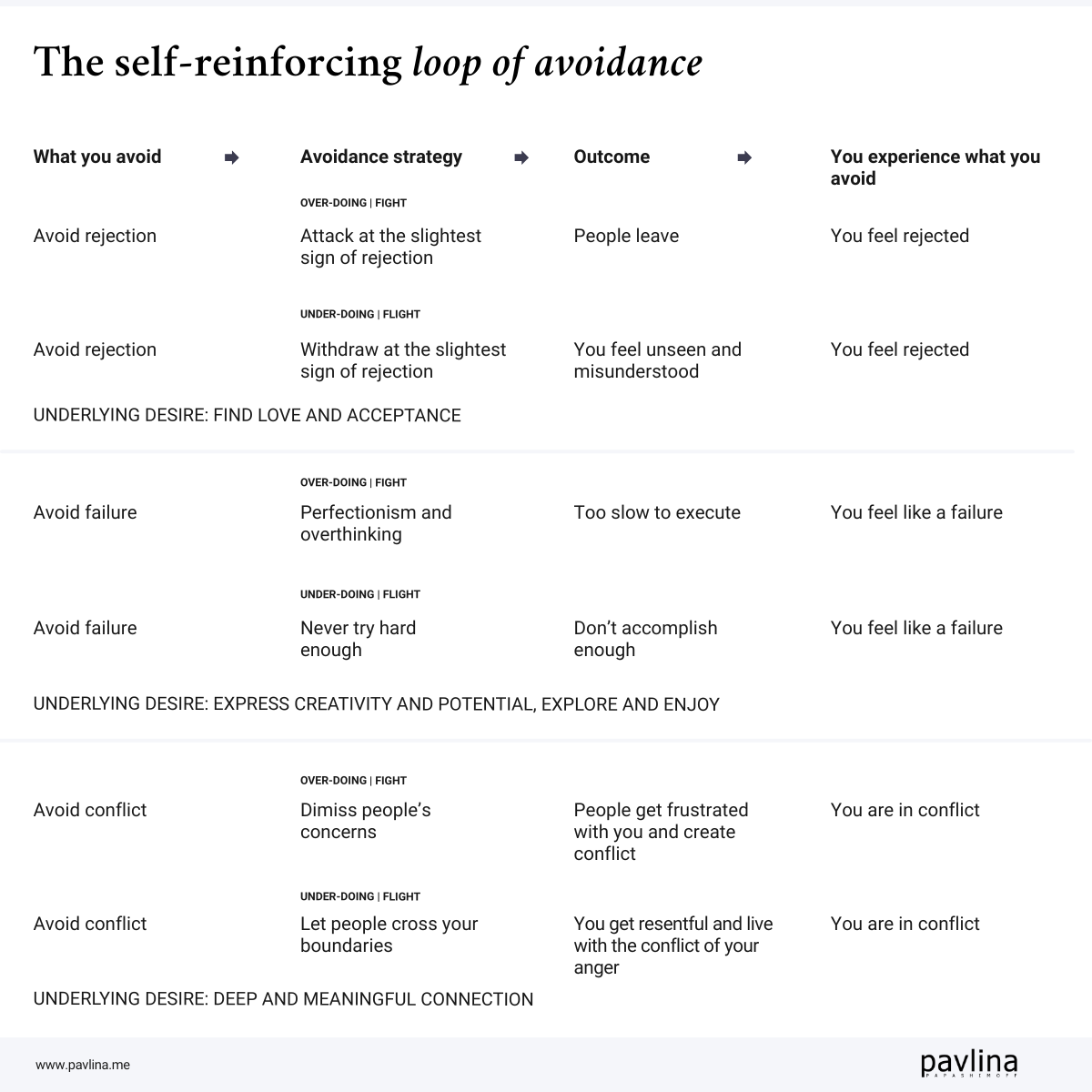
The self-reinforcing loop of avoidance: we experience what we avoid in the very act of avoiding it
Embracing versus bracing against your feelings
We are emotional beings. In his book, Descartes’ Error, neuroscientist António Damásio, challenges traditional ideas about the relationship between rationality and emotions, demonstrating that when the emotional part of our brain is suppressed, we struggle to make decisions.
If the area of the brain’s prefrontal cortex responsible for processing emotions is damaged, a person loses their ability to make effective decisions, even if they have a high IQ. For example, it would take someone several hours to decide where to have lunch.
Studies demonstrate that while we think that we make decisions based on logic, our feelings are actually the driving factor. We make decisions based on the emotion we anticipate we’d feel or avoid through the decision. And then, we use the logical side of our brain to justify the decision with reasoning.
Childhood programming and conditioning determines what we’re driven to avoid
The feelings we try to avoid are often programmed in childhood and are the by-product of childhood trauma. Childhood trauma is any removal of love or safety that a child experiences. Children are naturally very sensitive and when this happens we fail to process the resultant feelings, because they are too big for us and we don’t know how to deal with them.
The emotions of helplessness, grief, loneliness and uncertainty that result from feeling unworthy, rejected or abandoned are overwhelming experiences that children don’t have the capacity to navigate. When these feelings are evoked within us as children, rather than feeling them, which would allow them to move through us and free us, we close to them and push them away. That freezes them in place, leaving an open wound within us.
The trauma of the unprocessed feelings creates an internal separation from our true nature of joy, love, creativity and confidence, and a Wounded Inner Child Part emerges in response. That Wounded Inner Child Part tries to protect us from re-experiencing the hurt of the traumatic event by strategies of avoidance.
The emotions that most of us are trying to avoid are the unprocessed feelings of our Wounded Inner Child Parts.
We are driven by our core existential needs and corresponding fears
To survive as children, we need connection, safety and resources and to receive them we need to be visible and significant. Being worthy and valuable is as such our most fundamental need–because having the rest of our existential needs is contingent upon it.
Our core existential fears–irrelevance, abandonment, engulfment, attack and falling apart–are the fears of not having our core existential needs met. Experiences that confront us with those core existential fears are the experiences that most of us try to avoid. And the degree to which we are driven by these fears is the degree to which we’ve experienced traumatic childhood events that triggered the fears.
Core existential needs and the corresponding core existential fears
Core existential needs
a) Existence and significance
b) Connection and belonging
c) Safety and protection
d) Resources and abundance
Core existential fears
a) Invisibility, unworthiness, engulfment, neglect
b) Separation
c) Annihilation
d) Isolation, deprivation, lack
Experiences and feelings we commonly avoid:
Being dismissed, ignored, not considered. Being overlooked, invisible.
Being told what to do (park here, etc.)
Being excluded
Being attacked, criticised, ostracised–the group against me
Being insignificant, irrelevant, unworthy
Being less than, not being a priority
Judgement, controlling, perfectionism and people-pleasing are common avoidance strategies
Some of the most common avoidance strategies are addictions, judging others and ourselves, controlling behaviour, reacting and attacking, performing, producing and pleasing. All of these are ways in which we try not to feel our painful feelings by suppressing, distracting, numbing or soothing.
As a child I felt invisible, irrelevant and unwanted, and for over three decades I looked for love and belonging. But unbeknownst to me, I was driven by my fear of unworthiness. I looked for love, because I wanted to escape my feelings of shame, guilt, abandonment and rejection. And because I was playing not to lose, rather than playing to win, I kept on recreating the very experiences I was trying to avoid.
My fear that I wasn’t good enough left me overworking and overgiving in order to prove myself, only to feel that people didn’t appreciate the fullness of my contribution, which reinforced my feelings of inadequacy and not-enoughness.
To avoid loneliness I committed to unsuitable partners and then felt lonely in the relationship because I felt they didn’t see or get me.
My attempts to avoid failure resulted in analysis paralysis, which prevented me from taking action and made me feel like a failure.
Deep down, I craved connection, belonging and intimacy. But because I was coming at it from a fear-driven place, trying to avoid rejection, I kept on recreating and feeling abandonment and rejection.
The solution: you find true love, acceptance and worthiness when you stop rejecting yourself
The way out of the self-reinforcing loop of avoidance is not doing more, but healing the underlying fear and limiting belief that who you are is undeserving of your desires, goals and wants.
In other words, you find true love and acceptance, not when you find love and acceptance, but when you stop rejecting yourself.
How to break the cycle of self-rejection
Step 1: Identify your avoidance strategies: perfectionism, people-pleasing, self-judgement, judgement of others, attacking, passive aggression, busyness, overworking, addictions and compulsive behaviours are all protective strategies you might utilise to push away your unprocessed feelings and fears.
Step 2: Identify the emotions you’ve been avoiding. Look at the strategies you identified in step one, and ask yourself what emotions you’ve been trying to avoid with them. Also, if there are any unwelcome recurring patterns in your life–what are the underlying fears and emotional experiences associated with them? Abandonment? Rejection? Loneliness? Unworthiness? Failure?
Step 3: Feel the emotions and fears you’ve been avoiding. To do that, embrace them rather than brace against them. Move from being closed to and pushing away the hurtful feelings to opening to them and welcoming them. Feel them. And welcome and embrace them any time they re-appear.
In doing this, you will discover that the pain you associate with unwelcome feelings is not created by the feeling itself, but by your resistance to it. When you feel your sadness, you’d find that it actually opens to joy. Fear fully felt becomes excitement and invincibility. Loneliness, when felt, feels intimate, loving and connecting.
The benefits of feeling hurtful feelings
You think, feel and act from your true nature and core self, not from a Wounded Inner Child Part
Unfelt hurtful feelings and fears cause you to act from a wounded place rather than from your inherent wholeness and true nature. In other words, the ride is bumpy and volatile, because unbeknownst to you your Wounded Inner Child is behind the steering wheel rather than you, the Adult. Processing and feeling your hurtful feelings and fears liberates you to think, feel and act from your inherent true nature and wholeness rather than from a wounded place. You move from being driven by a Wounded Inner Child Part to being driven by your True Nature and Core Self.
Freedom from future fears
Your past hurts create your future fears. And when your future is littered with fears, you are driven by trying to avoid them–which only recreates them. Also, a future full of fears often causes present-life experiences of hopelessness, depression, anxiety and lack of motivation and aliveness. Feeling your future fears allows you to liberate your future from any doom and gloom your Wounded Inner Child Parts is projecting into a future that’s free, open and full of wonder and possibility by default.
Changing unwelcome habits, moving out of stuckness and reducing judgement and criticism of self and others
Anything that you’ve experienced stuckness around and haven’t been able to change for a while is connected to an unprocessed emotion that you’ve been avoiding.
Unwelcome habits, self-criticism and other-criticism are strategies we use in order to not feel our painful feelings. When we feel the feelings, the bad habits, inner war and judgement of others no longer serve a purpose and are free to go.
Self-acceptance, authenticity and inner peace
The resistance of your feelings is the resistance of who you are. Not feeling your feelings is a form of self-criticism, self-abandonment and self-judgement. The underlying message is this: it’s not okay to be who you are.
Pushing away your feelings and fears is self-rejection. Conversely, when you allow yourself to feel whatever you’re feeling, you are allowing and accepting of who you are. This brings the sense of inner peace, freedom, joy and possibility back into your life.
How to feel your feelings and fears
Step 1: Embrace the feeling: welcome it, allow it, feel it.
Move from resisting the feeling to welcoming and allowing it to touch you. Somatically, this means moving from bracing against it (holding, pushing, tension) to embracing it (relaxing, softening, releasing). From being closed to being open, physically. Feeling your feelings and fears is an embodied, whole-body experience.
Step 2: Drop your agenda.
Don’t look for an outcome, try to solve, figure out or get rid of the feeling–allow it, as it is, without an end-goal.
Step 3: Be with it, but don’t get lost in it.
Be in the emotion, but don’t get lost in it. Don’t observe it from distance, rather feel it. Yet, don’t identify with it or collapse your sense of self with it.
Step 4: Wonder about it.
Be in wonder about it. Explore it, with childlike curiosity and openness, not-knowing.
By virtue of childhood conditioning and trauma, we are often avoidant in the way we go about our desires and goals. The problem and irony of avoidance is this: you create what you’re trying to avoid in the act of avoiding it. You abandon yourself to avoid rejection, but self-abandonment is rejection. You chase connection with others, by suppressing your authentic self, and end up feeling disconnected. You try to get rid of your anxiety by pushing it away and end up feeling more anxious.
The way out of the vicious cycle of avoidance is by allowing, welcoming and feeling your full experience of life as it is, including your unprocessed childhood feelings and fears. This moves you from acting out of a wounded place into acting out of integrity, truth and wholeness. An expansive sense of self, inner peace, joy, aliveness and creativity are the markers of alignment with your true core self.